GENERAL DESCRIPTION
This carved limestone bust of a man, part of a Palmyrene funerary relief, reflects the cultural and religious ideas of Roman Syria, embodying a fusion of Near Eastern beliefs and realistic Roman portraiture styles. The stylized treatment of the hair and eyes combined with the stiffness of the hands and strict frontality, anticipates late Roman or Byzantine art. However, the bust as a whole has a hypnotizing immediacy due to the intense gaze from the man's incised eyes and its life-like size. The man featured in this bust wears a ring (to indicate status and rank more than personal adornment), and he carries a scroll, indicating that he was a merchant or scribe. Rhythmic waves of hair reflect an Italian bravura style of carving seen in some Roman portraiture, such as the Dallas Museum of Art's Antonine youth (1984.163). Like the DMA's Syro-Roman Head of a Priest (1994.51), realistic incised eyes and careful attention to detail combine to create an intense spiritual presence, integrating religion and culture. All together, these pieces illustrate the rich character and diversity of imperial art in the richest area of the Roman Empire.
Syria, generally, and Palmyra, specifically, were the western end of the fabled Silk Road, running from China to the Mediterranean. Contemporary Han China had a very productive trade with central Asia and Rome during the first centuries CE. Merchants in Syria made fortunes from this trade, which was not only in silk but also in Roman glass (1988.64), gems (1995.26), pearls (1996.35.A-B), incense, and many kinds of manufactured goods. As a result, Palmyra grew rich as a kind of independent middleman between Rome and traders from further east. Local families built huge family tombs, often including several generations and many effigies, to immortalize their clan line. Although the artistic style they used derived from Rome, the concept was Near Eastern. Some of these family tombs were the size of a house, or even a several story temple.
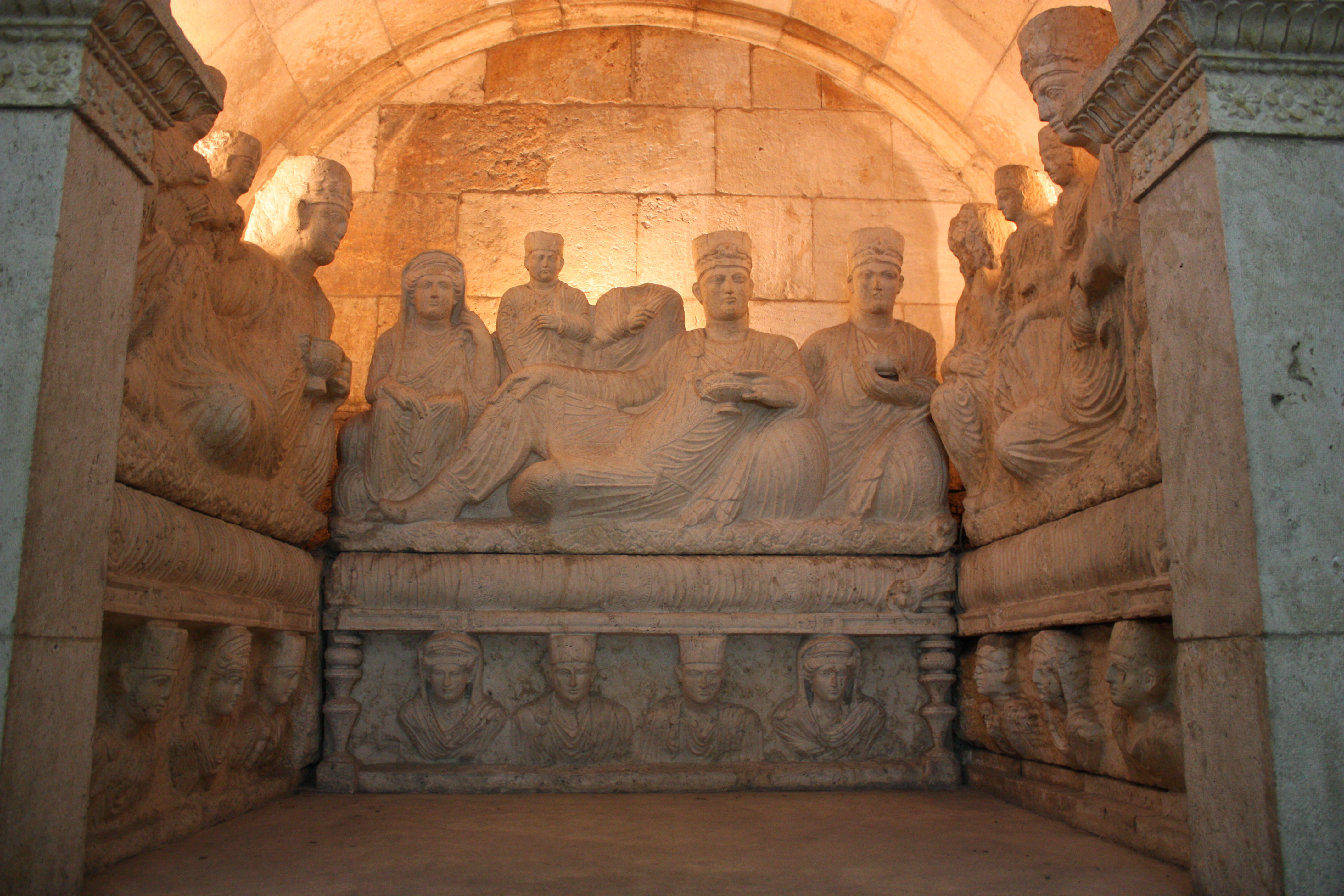
There is considerable variety in these Palmyrene bust/reliefs. Both men or woman are represented. Sometimes the portraits were made in life; sometimes family members commissioned them after a person's death. As generation followed generation, a very large number of funerary niches could be accumulated. One such impressive family tomb is reconstructed in the National Museum in Damascus, while there are numerous examples in Palmyra itself. Despite the life-like appearance of these busts, they really belong to fairly conventional types, many of which indicate the person's social role, as this one does.
Adapted from
Anne Bromberg, DMA unpublished material, 2002.
NOTES
- Need to add Wikimedia image as an image asset in Piction
- updated provenance and geo x refs in TMS
- added "Syro-Roman" as culture
- DMA unpublished material = Acquisition Justification, January 2002
Catalogue essays
Artist/designers
Cultures
Geography
Process/materials
Historical periods
Individuals
Subject terms
RELATED OBJECTS
PROVENANCE
From 2001: Dallas Museum of Art, gift of David T. Owsley via the Alvin and Lucy Owsley Foundation and the Alconda-Owsley Foundation in honor of Fred M. Penn, purchased at auction from Christie's New York, December 6, 2001, lot 726
AUDIO ASSETS
Listen to a lecture by Anne Bromberg entitled, 'Across the World: The Arts of the Silk Road', 13314700: UMO; 13314516: UMO
VIDEO ASSETS
IMAGE ASSETS
____________: UMO. Palmyrene tombs with busts in niches, Damascus, National Museum, Hypogeum of Yarhai, by Arian Zwegers [CC BY 2.0 (http://creativecommons.org/licenses/by/2.0)], via Wikimedia Commons
WEB RESOURCES
- Khan Academy~See Palmyrene funerary tombs with examples of funerary portraiture.
- Metropolitan Museum of Art~Compare to several similar funerary portraits from Palmyra.
- Louvre~See another Palmyrene funerary portrait.
- Archaeological Museum, Istanbul, Turkey~See a reconstructed Palmyrene tomb chamber.
ARCHIVAL RESOURCES
FUN FACTS
TEACHING IDEAS
RULES
Apply to objects where number equals 2001.332
Category
rules_operator
AND
General Description
This carved limestone bust of a man, part of a Palmyrene funerary relief, reflects the cultural and religious ideas of Roman Syria, embodying a fusion of Near Eastern beliefs and realistic Roman portraiture styles. The stylized treatment of the hair and eyes combined with the stiffness of the hands and strict frontality, anticipates late Roman or Byzantine art. However, the bust as a whole has a hypnotizing immediacy due to the intense gaze from the man's incised eyes and its life-like size. The man featured in this bust wears a ring (to indicate status and rank more than personal adornment), and he carries a scroll, indicating that he was a merchant or scribe. Rhythmic waves of hair reflect an Italian bravura style of carving seen in some Roman portraiture, such as the Dallas Museum of Art's Antonine youth (1984.163). Like the DMA's Syro-Roman Head of a Priest (1994.51), realistic incised eyes and careful attention to detail combine to create an intense spiritual presence, integrating religion and culture. All together, these pieces illustrate the rich character and diversity of imperial art in the richest area of the Roman Empire.
Syria, generally, and Palmyra, specifically, were the western end of the fabled Silk Road, running from China to the Mediterranean. Contemporary Han China had a very productive trade with central Asia and Rome during the first centuries CE. Merchants in Syria made fortunes from this trade, which was not only in silk but also in Roman glass (1988.64), gems (1995.26), pearls (1996.35.A-B), incense, and many kinds of manufactured goods. As a result, Palmyra grew rich as a kind of independent middleman between Rome and traders from further east. Local families built huge family tombs, often including several generations and many effigies, to immortalize their clan line. Although the artistic style they used derived from Rome, the concept was Near Eastern. Some of these family tombs were the size of a house, or even a several story temple.
There is considerable variety in these Palmyrene bust/reliefs. Both men or woman are represented. Sometimes the portraits were made in life; sometimes family members commissioned them after a person's death. As generation followed generation, a very large number of funerary niches could be accumulated. One such impressive family tomb is reconstructed in the National Museum in Damascus, while there are numerous examples in Palmyra itself. Despite the life-like appearance of these busts, they really belong to fairly conventional types, many of which indicate the person's social role, as this one does.
Adapted from
Anne Bromberg, DMA unpublished material, 2002.
Fun Facts
Archival Resources
Web Resources
- Khan Academy~See Palmyrene funerary tombs with examples of funerary portraiture.
- Metropolitan Museum of Art~Compare to several similar funerary portraits from Palmyra.
- Louvre~See another Palmyrene funerary portrait.
- Archaeological Museum, Istanbul, Turkey~See a reconstructed Palmyrene tomb chamber.
Notes
- Need to add Wikimedia image as an image asset in Piction
- updated provenance and geo x refs in TMS
- added "Syro-Roman" as culture
- DMA unpublished material = Acquisition Justification, January 2002
Catalogue essays
Artist/designers
Cultures
Geography
Process/materials
Historical periods
Individuals
Subject terms
RELATED OBJECTS
PROVENANCE
From 2001: Dallas Museum of Art, gift of David T. Owsley via the Alvin and Lucy Owsley Foundation and the Alconda-Owsley Foundation in honor of Fred M. Penn, purchased at auction from Christie's New York, December 6, 2001, lot 726
AUDIO ASSETS
Listen to a lecture by Anne Bromberg entitled, 'Across the World: The Arts of the Silk Road', 13314700: UMO; 13314516: UMO
VIDEO ASSETS
rules
Apply To
Objects
number
Equals
2001.332
source file
object_notes_2_b-0066.xml.nores