GENERAL DESCRIPTION
In 1879 John Singer Sargent, an American expatriate living in France, spent five months touring Spain and North Africa. At the time, fascination with the unknown aspects of Spanish and Moorish culture permeated Europe, inspiring literary works like Washington Irving's Tales of the Alhambra (1832, 1851) and George Bizet's opera Carmen (1875). Sargent returned to Paris with sketches of Spanish flamenco dancers and the germ of an idea for his first full-scale salon painting, El Jaleo (1882, Isabella Stewart Gardner Museum). El Jaleo, which translates from Spanish to mean "ruckus" or "uproar," depicts a dimly lit hall in which a lone performer pounds out her dance to the accompaniment of guitars and shouts.
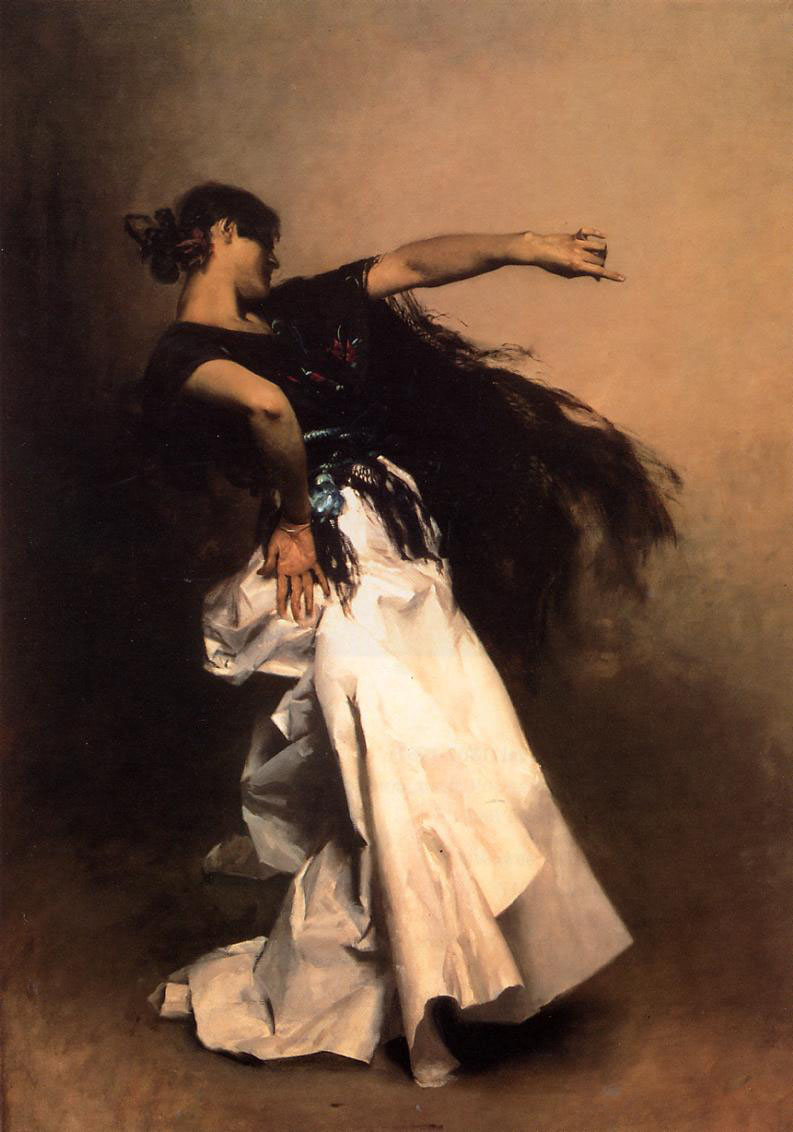
Sargent's composition for the monumental painting developed over three years through a series of drawings and watercolors. His principal effort went into the figure of the dancer, especially her gesture and dress. When it entered the Dallas Museum of Fine Art's collection, the Study for the "Spanish Dancer" appeared to be the final preliminary work for El Jaleo. The rediscovery of a full-size oil painting of this dancer, Sargent's first attempt to paint this subject, revised this association. It is the previously unknown work, titled Spanish Dancer (1880-1881, private collection), rather than for El Jaleo, that the Museum's watercolor relates to most directly, as the attitude and dress of the figure confirms.
Visual analysis of both the Study and the completed Spanish Dancer clarify Sargent's working method. Sargent's use of watercolor for a penultimate study is unusual. Sketching the basic forms in pencil, he deftly applied watercolor washes to give substance to the dancer's body and shawl, and to suggest the murky background. The dancer's skirts remain sketchily handled in this work; Sargent altered them once more in the Spanish Dancer. Sargent signed the watercolor, indicating his pleasure with its resolution, and its completion as a separate work of art in his mind.
Adapted from
Eleanor Jones Harvey, DMA electronic record (1974.1.FA), n.d.
NOTES
Text entries added to TMS:
- 2012 Guide entry
- 1997 Guide entry
- Anne Bromberg, docent materials, 1987
- Gail Davitt, artist biography, 1986
- Steven A. Nash, artist biography from Dallas Collects American Paintings (1982)
- Eleanor Jones Harvey, label copy
- Eleanor Jones Harvey, (text previously entered in curatorial remarks and closely resembling the 1997 Guide entry)
Added former title based on DMA records through at least 1990-- Study for El Jaleo
Changed the status of this note from routed to completed, June 21, 2016.
Adding "draft" tag back to note, Dec 19, 2016, as part of the revised harvest/route procedure. This note will be pulled into GDrive and manually moved to Queta's folders for final review. Update- January 18, 2017- Adding #routed tag so that I can easily keep track of this note in Evernote to confirm that it is eventually pushed into GDrive. As of January 18, 2017 the content is in Brain but not in GDrive so I am unable to finish revisions and mark it complete in Evernote or move the GDoc to Queta's folder.
Confirmed note updated in GDrive. Tagged completed and moved GDoc to Queta folder. (1/24/2017)
(October 2015)- Sue asked for the medium to be changed from watercolor on paper, to watercolor. This contradicts the revision process I intended to start doing in january 2016.
Moved the images listed under IMAGE ASSETS to be web resources as part of my revision process June 2016 to save time from Piction cataloging.
- The Spanish Dancer, study for 'El Jaleo', 1880-1881 (oil on canvas), Sargent, John Singer (1856-1925) / Private Collection / The Bridgeman Art Library. https://commons.wikimedia.org/wiki/File%3ASargent_John_Singer_Spanish_Dancer.jpg Image downloaded from Wikimedia, Public Domain; As of 1992, a National Gallery of Art publication on El Jaleo reproduces The Spanish Dancer with credit line to Dorothy and Wendell Cherry; UMO Pending
- John Singer Sargent, El Jaleo, 1882; oil on canvas, 232 x 348 cm (91.3 x 137 in); Isabella Stewart Garner Museum, P7s; Source/Photographer- The Bridgeman Art Library, Object 113859; Downloaded from Wikimedia Commons; UMO Pending

Added two geographies as places of origin- Paris (where it was made) and Seville (where he made the initial studies). I chose not to enter Seville as the depicted location because the work does not visually represent elements of the city.
Reformatted the following exhibition history to follow current formatting guide. (Put the exhibitions in chronological order, rearranged the date/title/site, and combined exhibitions that were at multiple venues.) NOTE- The 1968 exhibition does not include dates for these venues, and none of the exhibitions include information on any associated publications (published references).
"Influence of Velazquez on Modern Painting: The American Experience"
Federal Reserve Board, Fine Arts Program, Washington, D.C.
July 3 to December 1, 2000
"John Singer Sargent's El Jaleo"
National Gallery of Art, Washington, D.C.
March 1 to August 2, 1992
"John Singer Sargent"
Art Institute of Chicago, Chicago, Illinois
February 4 to April 17, 1987
"John Singer Sargent"
Whitney Museum of American Art, New York, New York
October 1, 1986 to January 4, 1987
"Eight American Masters of Watercolor"
Los Angeles County Museum of Art, M. H. de Young Memorial Museum,
San Francisco California
1968
"Eight American Masters of Watercolor"
Seattle Art Museum, Seattle, Washington
1968
Catalogue essays
Artist/designers
Cultures
Geography
Paris- place of origin
Seville- place of origin
Process/materials
Historical periods
Individuals
Subject terms
woman
dancer
motion
music
dress
study
gesture
flamenco
performance
wash technique
white
blue
black
hairstyle
skirt
shawl
RELATED OBJECTS
PROVENANCE
Until d. 1925: the artist (1856-1925)
After 1925: his sister, Mrs. Francis Ormond, by inheritance
Until 1967: her daughter, Mrs. Hugh Pitman, Odstock, Salisbury, England, by inheritance [1]
1967-1970: Stuart Feld, New York [2]
1970-1974: Hirschl and Adler Galleries, New York
From 1974: Dallas Museum of Fine Arts, Foundation for the Arts Collection, purchased from the above by Margaret J. and George V. Charlton [3], [4]
The main source for this provenance comes from documentation from Hirschl and Adler Galleries, January 9, 1974, in the Collections Records Object File. Exceptions and other supporting documents are noted.
[1] A clipped label packaged with acquisition materials in the DMA Collection Records Object File has a typed address for Mrs. Hugo Pitman, Odstock Manor, Odstock, Salisbury.
[2] Correspondence dated March 9, 1991 from Odile Duff, Research Director of the John Singer Sargent Catalogue Raisonné, to Elizabeth Simon at the Dallas Museum of Art includes the provenance assembled for the future publication and lists this line of ownership that was not included on earlier documents.
[3] The name of the Dallas Museum of Fine Arts, founded in 1933, was changed to the Dallas Museum of Art in 1983.
[4] The Foundation for the Arts is a non-profit corporation created as a title-holding entity to serve the people of Dallas but to operate independently of the City. The Dallas Museum of Art (at its own cost) is responsible for the care, storage, insurance, conservation and maintenance of the collection, and agrees to maintain the highest museum standards in the management and handling of the Foundation’s collection. The title to all works of art purchased or otherwise acquired by the Foundation for the Arts is retained by the Foundation.
AUDIO ASSETS
Warren Adelson, "John Singer Sargent," lecture 2001.
Description: speaker is director of Adelson Galleries, New York; discusses catalogue raisonne; Antique Arts Society presentation?
Location: Orientation Theater
13314436: UMO
13314644: UMO
VIDEO ASSETS
IMAGE ASSETS
WEB RESOURCES
- John Singer Sargent, The Spanish Dancer (study for El Jaleo), 1880-1881~See the work for which this preparatory painting was made (which in turn prepared the artist for the monumental El Jaleo.
- John Singer Sargent, El Jaleo, 1882~Look at the iconic painting of a flamenco dancer, now housed in the Isabella Stewart Gardner Museum in Boston.
- Sargent, El Jaleo, 1882~This Khan Academy webpage gives the context for Sargent's painting of a Spanish dancer.
- El Jaleo subject, analysis, and reception~Artble offers an in depth examination of Sargent's famous painting at the Isabella Stewart Gardner Museum.

ARCHIVAL RESOURCES
FUN FACTS
TEACHING IDEAS
RULES
Apply to objects where number equals 1974.1.FA
Category
rules_operator
AND
General Description
In 1879 John Singer Sargent, an American expatriate living in France, spent five months touring Spain and North Africa. At the time, fascination with the unknown aspects of Spanish and Moorish culture permeated Europe, inspiring literary works like Washington Irving's Tales of the Alhambra (1832, 1851) and George Bizet's opera Carmen (1875). Sargent returned to Paris with sketches of Spanish flamenco dancers and the germ of an idea for his first full-scale salon painting, El Jaleo (1882, Isabella Stewart Gardner Museum). El Jaleo, which translates from Spanish to mean "ruckus" or "uproar," depicts a dimly lit hall in which a lone performer pounds out her dance to the accompaniment of guitars and shouts.
Sargent's composition for the monumental painting developed over three years through a series of drawings and watercolors. His principal effort went into the figure of the dancer, especially her gesture and dress. When it entered the Dallas Museum of Fine Art's collection, the Study for the "Spanish Dancer" appeared to be the final preliminary work for El Jaleo. The rediscovery of a full-size oil painting of this dancer, Sargent's first attempt to paint this subject, revised this association. It is the previously unknown work, titled Spanish Dancer (1880-1881, private collection), rather than for El Jaleo, that the Museum's watercolor relates to most directly, as the attitude and dress of the figure confirms.
Visual analysis of both the Study and the completed Spanish Dancer clarify Sargent's working method. Sargent's use of watercolor for a penultimate study is unusual. Sketching the basic forms in pencil, he deftly applied watercolor washes to give substance to the dancer's body and shawl, and to suggest the murky background. The dancer's skirts remain sketchily handled in this work; Sargent altered them once more in the Spanish Dancer. Sargent signed the watercolor, indicating his pleasure with its resolution, and its completion as a separate work of art in his mind.
Adapted from
Eleanor Jones Harvey, DMA electronic record (1974.1.FA), n.d.
Fun Facts
Archival Resources
Web Resources
- John Singer Sargent, The Spanish Dancer (study for El Jaleo), 1880-1881~See the work for which this preparatory painting was made (which in turn prepared the artist for the monumental El Jaleo.
- John Singer Sargent, El Jaleo, 1882~Look at the iconic painting of a flamenco dancer, now housed in the Isabella Stewart Gardner Museum in Boston.
- Sargent, El Jaleo, 1882~This Khan Academy webpage gives the context for Sargent's painting of a Spanish dancer.
- El Jaleo subject, analysis, and reception~Artble offers an in depth examination of Sargent's famous painting at the Isabella Stewart Gardner Museum.
Notes
Text entries added to TMS:
- 2012 Guide entry
- 1997 Guide entry
- Anne Bromberg, docent materials, 1987
- Gail Davitt, artist biography, 1986
- Steven A. Nash, artist biography from Dallas Collects American Paintings (1982)
- Eleanor Jones Harvey, label copy
- Eleanor Jones Harvey, (text previously entered in curatorial remarks and closely resembling the 1997 Guide entry)
Added former title based on DMA records through at least 1990-- Study for El Jaleo
Changed the status of this note from routed to completed, June 21, 2016.
Adding "draft" tag back to note, Dec 19, 2016, as part of the revised harvest/route procedure. This note will be pulled into GDrive and manually moved to Queta's folders for final review. Update- January 18, 2017- Adding #routed tag so that I can easily keep track of this note in Evernote to confirm that it is eventually pushed into GDrive. As of January 18, 2017 the content is in Brain but not in GDrive so I am unable to finish revisions and mark it complete in Evernote or move the GDoc to Queta's folder.
Confirmed note updated in GDrive. Tagged completed and moved GDoc to Queta folder. (1/24/2017)
(October 2015)- Sue asked for the medium to be changed from watercolor on paper, to watercolor. This contradicts the revision process I intended to start doing in january 2016.
Moved the images listed under
rules
Apply To
Objects
number
Equals
1974.1.FA
source file
object_notes_3_c-0307.xml.nores