GENERAL DESCRIPTION
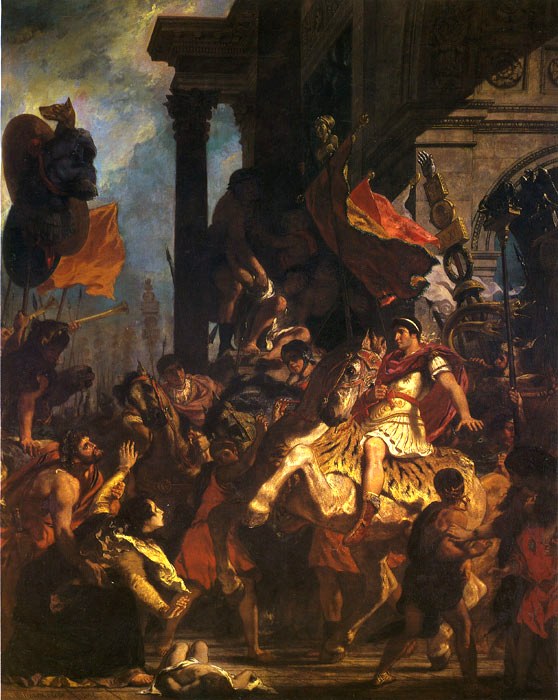
Exhibited at the Salon of 1840 and currently in the collection of the Musée des Beaux-Arts, Rouen, the monumental painting The Justice of Trajan (La Justice de Trajan), inspired by Canto X of Dante Alighieri’s Purgatorio (from The Divine Comedy), was the subject of several dozen preparatory drawings, the largest of which rehearse the composition as a whole. Some studies of details exist, including this example, whose three main motifs concern the young man seen from behind in the right foreground of the painting. The strong modelling of the muscular back shows Delacroix's interest in classical sculpture as an artistic source and carries the painterly, expressive graphic effects that characterize Delacroix's romantic style.
Delacroix drew variants of his headdress with its characteristic headband. The feminine head and the hand seem to belong to two less prominent and somewhat overshadowed figures at the center of the composition. “I thought of putting a group of people climbing on columns,” Delacroix wrote to Frédéric Villot while in the throes of composing his painting. [1] As a result, the figures observe the scene from between the columns.
[1] Delacroix to Villot, November 4, 1839, Correspondance générale d'Eugène Delacroix (Paris: Plon, 1937–45).
Adapted from
Louis-Antoine Prat, in Mind's Eye: Masterworks on Paper from David to Cézanne, eds. Olivier Meslay and William B. Jordan (Dallas Museum of Art; New Haven, NJ: Yale University Press, 2014) 40.
NOTES
Added 1982 exhibition to TMS and entered the former title used in that catalogue. (Hazlitt, Gooden & Fox, London, Nineteenth-Century French Drawings, June 10–July 8, 1982, cat. 31, pl. 23; as "Etudes de tetes et d'un torse d'homme.")
Entered Minds Eye catalogue entry and Steven Nash's acquisition justification as text entries.
Revised citation for the Bromberg, 1983 text in text entry.
Removed TMS tag because rule exists.
Provenance (not public)
n.d: Private collection, Europe
By 1982: Hazlitt, Gooden & Fox, London
From 1982: Dallas Museum of Fine Arts, purchased from the above by Essie Bromberg Joseph as a gift to the Museum [1]
Notes:
The main source for this provenance is Olivier Meslay and William B. Jordan, eds. Mind's Eye: Masterworks on Paper from David to Cézanne (Dallas Museum of Art; New Haven, NJ: Yale University Press, 2014) 40. Exceptions and other supporting documents are noted.
[1] The name of the Dallas Museum of Fine Arts, founded in 1933, was changed to the Dallas Museum of Art in 1983.
Catalogue essays
Artist/designers
Cultures
Geography
Place of origin: Paris (France): TGN: 7008038
Process/materials
paper
pencil
Historical periods
Individuals
Dante Alighieri
Frederic Villot
Emperor Trajan
Subject terms
modeling
study
preparatory drawing
justice
headdress
hairstyle
foreground
figures
exhibitions
Classical Greece
Roman (ancient style)
RELATED OBJECTS
PROVENANCE
AUDIO ASSETS
VIDEO ASSETS
IMAGE ASSETS
WEB RESOURCES
- Eugène Delacroix, The Justice of Trajan, (1840)~See the completed painting in the collection of the Musée des Beaux Arts de Rouen.
ARCHIVAL RESOURCES
FUN FACTS
- The scene shown in the completed painting shows the Emperor Trajan on horseback, leading his army to war. His steed rears back when he encounters a widow kneeling in the path. She was demanding justice for the death of her son, who, according to the legend, was trampled by a horse belonging to Trajan's son.
TEACHING IDEAS
RULES
Apply to objects where number equals 1982.40
Category
rules_operator
AND
General Description
Exhibited at the Salon of 1840 and currently in the collection of the Musée des Beaux-Arts, Rouen, the monumental painting The Justice of Trajan (La Justice de Trajan), inspired by Canto X of Dante Alighieri’s Purgatorio (from The Divine Comedy), was the subject of several dozen preparatory drawings, the largest of which rehearse the composition as a whole. Some studies of details exist, including this example, whose three main motifs concern the young man seen from behind in the right foreground of the painting. The strong modelling of the muscular back shows Delacroix's interest in classical sculpture as an artistic source and carries the painterly, expressive graphic effects that characterize Delacroix's romantic style.
Delacroix drew variants of his headdress with its characteristic headband. The feminine head and the hand seem to belong to two less prominent and somewhat overshadowed figures at the center of the composition. “I thought of putting a group of people climbing on columns,” Delacroix wrote to Frédéric Villot while in the throes of composing his painting. [1] As a result, the figures observe the scene from between the columns.
[1] Delacroix to Villot, November 4, 1839, Correspondance générale d'Eugène Delacroix (Paris: Plon, 1937–45).
Adapted from
Louis-Antoine Prat, in Mind's Eye: Masterworks on Paper from David to Cézanne, eds. Olivier Meslay and William B. Jordan (Dallas Museum of Art; New Haven, NJ: Yale University Press, 2014) 40.
Fun Facts
- The scene shown in the completed painting shows the Emperor Trajan on horseback, leading his army to war. His steed rears back when he encounters a widow kneeling in the path. She was demanding justice for the death of her son, who, according to the legend, was trampled by a horse belonging to Trajan's son.
Archival Resources
Web Resources
- Eugène Delacroix, The Justice of Trajan, (1840)~See the completed painting in the collection of the Musée des Beaux Arts de Rouen.
Notes
Added 1982 exhibition to TMS and entered the former title used in that catalogue. (Hazlitt, Gooden & Fox, London, Nineteenth-Century French Drawings, June 10–July 8, 1982, cat. 31, pl. 23; as "Etudes de tetes et d'un torse d'homme.")
Entered Minds Eye catalogue entry and Steven Nash's acquisition justification as text entries.
Revised citation for the Bromberg, 1983 text in text entry.
Removed TMS tag because rule exists.
Provenance (not public)
n.d: Private collection, Europe
By 1982: Hazlitt, Gooden & Fox, London
From 1982: Dallas Museum of Fine Arts, purchased from the above by Essie Bromberg Joseph as a gift to the Museum [1]
Notes:
The main source for this provenance is Olivier Meslay and William B. Jordan, eds. Mind's Eye: Masterworks on Paper from David to Cézanne (Dallas Museum of Art; New Haven, NJ: Yale University Press, 2014) 40. Exceptions and other supporting documents are noted.
[1] The name of the Dallas Museum of Fine Arts, founded in 1933, was changed to the Dallas Museum of Art in 1983.
Catalogue essays
Artist/designers
Cultures
Geography
Place of origin: Paris (France): TGN: 7008038
Process/materials
paper
pencil
Historical periods
Individuals
Dante Alighieri
Frederic Villot
Emperor Trajan
Subject terms
modeling
study
preparatory drawing
justice
headdress
hairstyle
foreground
figures
exhibitions
Classical Greece
Roman (ancient style)
RELATED OBJECTS
PROVENANCE
AUDIO ASSETS
VIDEO ASSETS
rules
Apply To
Objects
number
Equals
1982.40
source file
object_notes_2_b-0274.xml.nores